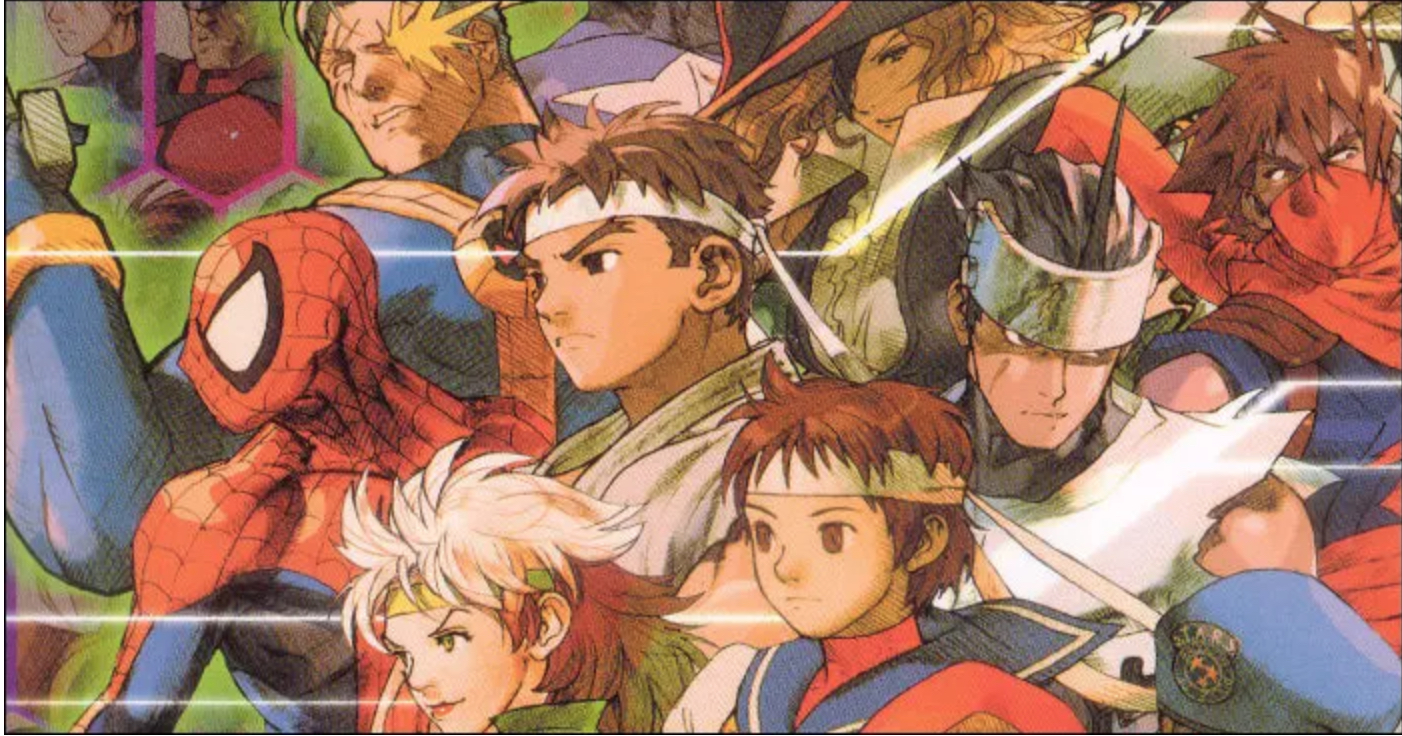
YouTube’s algorithm dug out a video for me the other day about the funky jazz-rock fusion soundtrack to Marvel vs. Capcom 2. I’m not a fighting-game aficionado—although I am familiar with Street Fighter II for the SNES, so much that I still remember how to perform a hadouken—but I do love some jazz fusion, mostly Casiopea.
My best attempt at describing the soundtrack is caffeinated jazz-funk, the kind of music I’ve heard in games like Super Mario Kart 8. It’s fast, syncopated, and jovial as all hell. The video creator sums up the feeling produced by how it makes your head move: rock makes your head thrash up and down, and funk puts some stank on your face and causes your head to bob like a chicken.1 Hilarious.
There’s truth to it, though, because funk is less about emphasizing the downbeat and more about highlighting what happens away from the strong beats. The effect can be disorienting since we gravitate towards the downbeat for its resolution and calmness. Something on the beat is predictable, but syncopation creates tension that needs to be released with a strong downbeat resolution.
But back to the video. What really piqued my interest was an aside made about how this soundtrack was poorly received, panned actually, as seen by the many reviewers at the time who lamented how unfitting it was. They described it as elevator music and lounge music completely at odds with the vibe of the game. What is this vibe? I suppose it’s combative, two players facing off until one remains. Apparently jazz-funk fusion induces… what? The reviewers don’t elaborate, but they reach for the nearest pejorative term: elevator music, a general cultural diss directed at music that annoys the listener. Is it an honest musical critique or a dismissal based on something unfamiliar? Jeff Gerstmann commits one paragraph to describing the music, negatively, but it is revealing:
While previous games have been accompanied by the typical style of rock and techno that make up most game soundtracks, MVC2 features a strange sort of jazzy lounge music. You’ll either love it because it’s so hilariously out of place or be annoyed to death by its happy, upbeat rhythms.2
It’s strange lounge music that is either annoying, hilariously out of place, or too happy. This means that at some level music within media like games serves a purpose. It must complement the action. And perhaps rock and techno hype players up to fight, while jazz-fusion is so hyper-joyous it irritates them.
But do we agree that all music serves this purpose, to fill the backdrop of our lives, to calm us or invigorate us? When I put on a playlist in the car, do I subconsciously gravitate towards a certain mood? Put on some classical music next time you’re driving somewhere with friends and wait for the comments of “what the hell are we listening to?” It will offend just like the MVC2 soundtrack did. If I were to guess, my friends in the car want something upbeat and fun, something that invigorates the spirit, not something… smooth? But I throw on Casiopea because it’s fun and groovy, whereas others see it as irritating. Even ambient music can frustrate (just put it on at your next party).
What is further fascinating is the idea that we all have our own expectations. I remember in school I took a class on world music. One of the study areas was Beijing opera, and one of the songs was The Drunken Concubine. This style of music uses pitch-bending and inflection in a way that sounds shrill and dissonant to western ears. I grabbed a coffee outside the class during a break, and the lady serving the coffee noted how it was one of her favourite pieces, describing it as beautiful. It all came full circle.
My next logical step is to ask where the term elevator music comes from since it means bad in most contexts, but why? As the term suggests, it’s meant for elevators. These machines, at their inception, were scary, and companies installing them worried that people would be hesitant to use them.3At first many lifts employed people to accompany riders to calm them—I suppose a friendly face can have that effect—but later that became obsolete with the advent of calming music, the kind which is unobtrusive, aka elevator music. Soft strings, flutes, orchestral tones, environmental noise, predictable rhythms; anything to take our minds off of the fact we are riding a box suspended by cables—which could snap at any moment!
Erik Satie, an early proponent of music serving a function, had a similar idea with his furniture music, which is music to accompany people eating and socialising. He wanted to fill in the silences, cover up the clanging of silverware, and drown out unwanted noises like traffic. The story goes that when he tried to play it for people, they kept on listening and paying too much attention, which was not the point.4 I suppose the cultural norms suggested music was to take all our attention when played in public by performers. Today, however, I’m sure some of us have sat in a restaurant with a folk duo in the background, or a jazz trio set to low. And if it gets too loud, as I’ve experienced playing jazz in such a place, you will annoy some people, and you will be told to turn down. It kills the ambiance.
So we have certain expectations of music, and associations with certain environments, that become culturally ingrained to the point of familiarity, and anything opposed to that sense of comfort is regarded with suspicion. MVC2 players expected upbeat rock and techno music when they played, not music meant to induce calm in an elevator. But the music itself, interestingly enough, is not calming, nor is it unobtrusive. In fact it is offensive, as evidenced by reviews. A better description is ill-fitted. Even closer is the word alien.
But why not chill out when playing a fighting game? Well, back in the year 2000 people expected rock and techno to accompany their arcade fighting games. They also expected their favorite characters to have familiar themes, the nostalgic callbacks associated with that genre of music called easy-listening, but what players got was something alien.
This births irritation, and we lunge towards something we associate with the uninspired: elevator/lounge music; in other words, it has everything to do with something that has become expected, and not much to do with the music itself.
None of this is to say that all music can accompany anything. Arnold Schoenberg commented that music set to media tended to reveal its secret meaning, and this is true.5Doom (2016), for instance, is an action-horror game, and I can’t imagine jazz-fusion enhances this darker vibe. But then again…I could see Persona 5 sporting some heavy metal, even though it’s jazzy. However, we do expect our games to be accompanied by music that enhances its mood, and straying too far from the expected formula is risky.
But let’s not hate on MVC2’s soundtrack so much; it has room for experimentation and growth. Just listen to Gran Turismo for PS1 compared to Gran Turismo 7 and notice how much that music has evolved. The 7th installment alone has classical music and funky electronica in the same game—and smooth jazz, whoa!
When music irritates us it’s worth asking why so we can push past a genre label like lounge or elevator—is the music really suited to a lift? Maybe the music is just too jovial, too busy, and wildly syncopated to the point of nausea. Maybe it just isn’t what I expected. For me, some of the tunes work well in the game, but some of them are a bit slammed and overloaded, and yes, hyper-joyous. But it cooks, and after a bit of time watching the game, I’m jazzed.
Listening to: Midnight Rendezvous by Casiopea
3. Lanza, Joseph. Elevator Music: A Surreal History of Muzak, Easy-listening, and Other Moodsong, University of Michigan Press (2004)
4.Lanza, Joseph. Elevator Music: A Surreal History of Muzak, Easy-listening, and Other Moodsong, University of Michigan Press (2004)
5.The World as Will and Idea