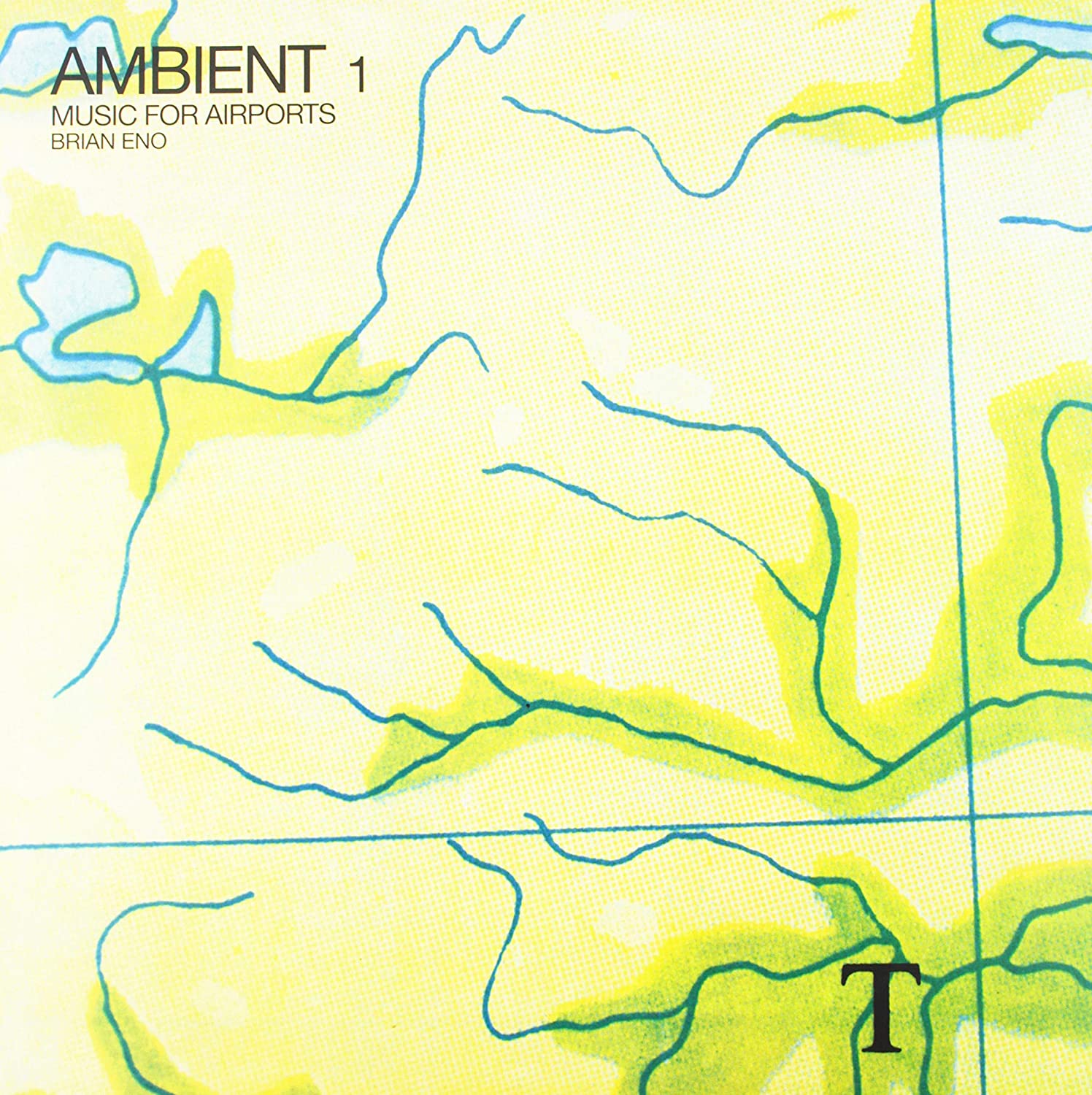
Brian Eno’s Ambient 1 : Music for Airports by John Lysaker explores the inception and history of ambient music by exploring Brian Eno’s album Music for Airports. Lysaker argues that Eno—and other avant-garde composers—created a sonic turn in music history, one which emphasized texture, timbre, and sound. Eno’s ambient music seems to lack stark dynamics, predictable rhythm, and sweeping emotion, choosing to focus on musical elements outside the tropes of the 12 tone scale. Eno sparked “generative music,” a type of music which focuses on the process itself. Instead of making a multitude of decisions to achieve a controlled performance, he creates a set of simple parameters which are then set up as guidelines rather than strict and repeatable events. Essentially, the music he makes is less confined by an adherence to certain musical forms (when we hear Bach, a certain set of expectations is…expected, for example).
I find this relevant since I get caught up in refining my work to the point where I may be putting value in ideas that never had much resonance anyway. Every detail is refined—but is it better for it, or is something salient lost? Sometimes I can’t tell, and I wonder if a simple procedure would have worked better.
I find the term “non-musician” resonates here, as it emphasizes general theories to propel creative activity. Lysaker outlines non-musician traits as :
(a) minimal to modest technique (but no virtuosity)
(b) self-trust in intuitive judgments, and
(c) a willingness to let more general theories (as opposed to music theory) propel his creative efforts.
Electronic music allows for creative output without robust theoretical knowledge since one only needs to know how to sculpt sounds, which itself may be argued as music theory, but it involves practice not often associated with traditional composition, such as decisions with regard to design, and by extension musical elements lower on the hierarchy of composition like timbre and texture. The composer studies the spectrum of sound, uses varied sound sources, and experiments with how sounds can change over time. Perhaps a simple decision is made : Micro-tones with one software synth. There is no virtuosity or specific theory necessary. Eno notes that such simple decisions can lead to complex works : “Very, very simple rules clustering together, can produce very complex and actually rather beautiful results.”
This opens up a rich creative process, of which sounds are sculpted in various and subtle ways. Simple choices and restrictions create a new sort of creativity : “Variation in simple procedures,” as Lysaker says. Eno, regarding himself as a non-musician, works with the knowledge he has (not necessarily traditional music theory) to create music, which leads to interesting results. His arts background may allow him to think differently about the music creation process, whereas my interest in sound design may inform mine.
I say all this to note a sort of freedom where traditional notions of composition are excluded. My bad habit is to overthink music creation, and I often turn to my training in music composition and theory to “correct” what I hear as imperfections. Maybe I want to add a whole band soli, or there is pressure to change keys, or add new harmony; all of these thoughts can clog up creative flow. This process is fine, but it can lead to perfectionism at its worst, and, again, I wonder if I’ve spent too much time investing in something that lacks legs.
Alternatively, a composition becomes, paraphrasing Michael Nyman, a situation where sounds may occur, rather than calculated relationships arranged in a particular fashion. My instinct is to control sounds so they sound a certain way. The horse and rider metaphor seems salient here : Music is the horse, and the composer the rider trying to yoke the horse into submission. Too much demand for control can harm this relationship, as both the horse and rider need some freedom to choose. It pains me at times to “let it be,” but too much calculation is wasted energy when the sounds are creating interesting results without strict input. Ambient music in particular can break up the demand for order to the point of frustration or irrelevance for the listener, but digging deeper may open up an appreciation for a new aesthetic, if only we can bear the discomfort of failed expectations.
Another great point made in the book is that how we create music is informed by how an audience listens to it. Is the music I’m making made for “performance?” I find this important to consider since I often lose myself in meaning-making within my music. Is it rock, jazz, or ambient? This is decided by the audience, whether I like the result or not. I could make music that I believe is melodically rich, but listeners find it calming in its vagueness. I’m tempted to see this as a failure on my part as the creator, but I’m missing the bigger picture : The listener is part of the creative process, as they make sense of something I’ve created. It’s a bit philosophical. However, I relax knowing that anything I create is open to interpretation. What I’m making is a set of guidelines rather than strict forms which are easily repeated.
Besides, many people—as Lysaker notes—listen to music in a narcissistic way : “Listening habits that only attend to their own fluctuating affections are narcissistic rather than responsive. The object is only an occasion for another self-relation, which is quite different from familiarizing oneself with and learning from the creative strivings of others.” Thus the artist makes music for an indeterminate audience. It’s the audience who puts self-importance into the work, unless the band itself advocates for some kind of affections towards their own music. The artist has laboured over her creation and set it free, but the audience may only pay attention to the melody, which—in the case of some ambient music—may be absent on purpose (or not on purpose, maybe it was never considered).
The creative process can be a set of simple decisions, that even when filled with specific intent, may fall differently on the listener. There’s less pressure. Maybe what I’m creating can have a function, such as setting an atmosphere, and that’s fine, but if it’s interpreted differently, that can also be exciting. The more open-ended the system of creation, the greater the difference in other renditions, which itself can produce interesting results. I could create work with selection and chance interwoven into it, and that opens art to interpretation by others in a broader sense. Without strict defined borders my piece is an open work. There is no correct way to play it. I do worry about my work being “performed”—can real people play this?— but even Eno’s ambient work can shift to performance art with enough imagination (the band “Bang on a Can” rendered “Music for Airports” into a live performance).
All this is to say that I feel quicker when I create, which is also to say that I will still get stuck making too many decisions, or land in a rut where my mind is an endless expanse of desert and tumbleweeds whistling across scorched Earth. But there is a weight lifted, or, at the very least, I feel a drive to create without endless revisions. Music is heard in a multitude of ways depending on the listener and how they listen, or where it’s listened, and on what kind of system. Plus, the more I try to grab the listener’s attention, the less interested they may become—life itself can be mundane, unpredictable, repetitive, varied, fading in and out; music can mimic this, too. I’ll just let it go and try to shield myself from overthinking it, perhaps I’ll set the mood by listening to Music for Airports.