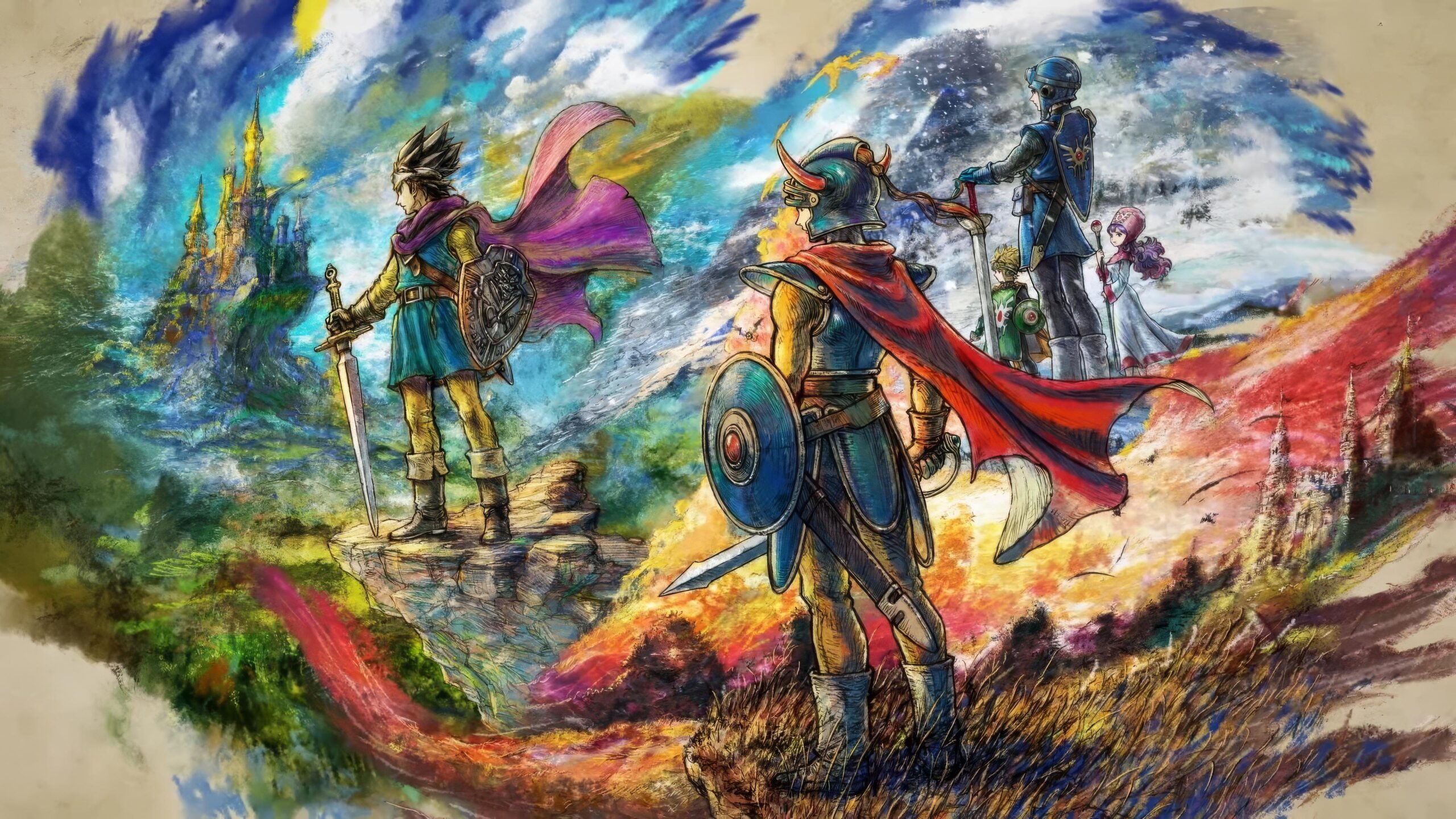
When I first played Dragon Quest III as a kid, I fought one random encounter after the next until I had the stats, gold, and resources to overcome the next area. This simple yet satisfying loop has earned the game a reputation for monotonous grinding. But I’ve revisited the game and discovered an elegant system at work, one that reserves grinding as one viable strategy. In truth, Dragon Quest III has complex game mechanics that improve pacing through high levels of tension which, consequently, make every decision matter.
Strong enemy encounters and punishing deaths are the first hints the developers give to encourage grinding for levels. But this takes time, and is quite repetitive. I need quicker gameplay that doesn’t kill the pacing. Pacing, though, is created through stakes, in the sense of wagering something you don’t want to lose. In DQ III, this is gold and progress. Gold buys me better equipment and healing items, and it’s used to revive dead characters. Progress is evident: I have to retry a difficult area with less resources when I die.
Punishment best describes the stress created by wagering progress and gold. It’s a fear of loss that keeps us engaged, and DQ III maintains this tension through several gameplay mechanics: running, attacking, boss battles, death, and revival.
I overlooked running in the beginning, but it’s a core mechanic. You can run from regular battles in DQ III with increasing odds to escape with each try: 25% chance, then 50%, then 75%, then 100%. Having a low percentage chance to run on first try increases pace through a wager: should I risk it? If I succeed then tough enemies can be avoided, and I can cherry pick less daunting encounters. I can run, for example, from a nasty formation of enemies who inflict status effects like sleep and poison, and those with attacks and spells that damage the whole party. But if I fail, I may be affected with sleep, and you can’t run or act if the whole party is asleep, leading to a sure death. However, my wager has potential benefits that goad me into taking a chance. Enemies have multiple attacks, some less damaging than others, and spells like sleep can fail to land. I may live to fight an easier battle, or make it back to town to heal.
Fighting is another option. If I do choose to act, rather than run, my party members can dazzle enemies, reducing accuracy, or put them to sleep, or seal away their spells. But this, too, is a measured decision; I need to act first, the attacks need to land— many enemies are 30% susceptible to status effects, and others immune—and my party must conserve resources. We have limited health points and magic points, so I might also lose the option to fight—and gain experience points—if I am careless with supplies.
The developers, though, have added skill checks: you can’t run from bosses. Bosses act as gatekeepers to endless running. At some point, I have to level, but how much depends on how I exploit a boss’s weaknesses.
My goal in every boss battle is to reduce the time spent fighting. Longer fights give the enemy more chances to attack, and require more party resources. One tactic to achieve this is buffs and debuffs. The first boss in DQ III, Kandar, for instance, is weak to spells that reduce accuracy and defence. By lowering his stats, I shorten the time it takes to kill him, reducing the time he has to damage me. In addition, I can buff my party with a spell called increase that improves defence against physical attacks, which is the only way Kandar inflicts damage. Still, Kandar has a random chance to land a critical hit that ignores buffs, adding a countermeasure which keeps tension high (he can kill a party member before I buff defence as well). But with enough luck, and keen decisions, I can win this fight with lower resources. This increases the pacing and tension since a death here is more likely, and, as mentioned, failure is punished by losing gold and progress.
The healing system is engaging, too, since the game lacks a reliable full-heal spell or item until later levels. A convenient way to revive party members is also absent—Yggdrasil leaves, full revives, are in short supply, with one permitted in your inventory at a time. This may seem too punishing, but it makes all dungeon runs, encounters, and bosses formidable. You can’t rely on healing alone. Staying on the offensive and using status-afflicting attacks and debuffs become a must, as does knowing enemy skills and behaviours. Ignoring this leads to death; and once a party member dies, they stay dead until you return to town and pay to revive them, or you use your precious leaf.
DQ III creates further suspense with boss counter buffs and attacks. Yes you can buff your party with increased defence, agility, and attack, but some bosses have the ability to dispel magic effects. They also heal a certain amount of health points per turn—never disclosed to the player—making sitting back and turtling a poor strategy. I have to stay on the offensive, while also weighing my defensive options. This is likely a limitation of the original hardware, as bosses could only be programmed with so much health, but the side effect is welcome. Now I have more options to consider, and the complexity of the encounter has increased.
To tie this all together, let’s walk through a fight against a boss nearer the end of the game, Baramos. Baramos can physically attack, use a party-wide breath attack, and cast a spell called explodet that deals heavy damage to the entire party. He’s susceptible to sleep, stopspell, sap (lowers defence), and surround (lowers accuracy). All of these attacks have a certain chance to work, making them risky. He also has a random chance to attack 1, 2, or 3 times in a turn. Thus a viable strategy here is to put him to sleep, reduce his defence, cast debuffs, increase my speed and attack, and hope I don’t get annihilated. Every death is a chance to rethink my approach: should someone else be a dedicated support character; who should be available for an emergency; and how can I keep damage up while keeping HP high?
Despite these mechanics, grinding is inevitable. There are challenges too great to pass at low levels.
Even this grind, though, becomes an engaging gameplay mechanic. For one, you can choose to grind in areas with enemies—metal slimes and babbles—that provide high amounts of experience points. My success rate at killing these monsters requires strategy. They both have a high chance to run, a high chance to evade hits, and they can take multiple strikes to kill, plus they are usually surrounded by strong enemies. In DQ III, metal slimes are weak to the confusion status effect, as are some of the enemies that surround them, which makes this a viable strategy—also involving luck—to kill them quickly. Plus there are items that have a small chance to kill an enemy instantly. In short, I need to use all the resources the game has to offer, and decide when I’ve gained enough EXP to cross the next threshold.
The strengths of the original are exemplified by the DQ III HD Remake that was released in 2024. I enjoyed the game, but found that it spun its wheels a bit, taking 1 step forward and 2 steps back. It’s a comfortable game compared to the original: you can retry any battle for free, or resume from autosaves, eliminating the anxiety of failure; many items have additional resistances for fire and ice attacks, reducing the need for buffs; there are items littered all over the map that make gold loss trivial since they can be sold; Baramos can no longer be put to sleep for as long, nor can his spells be sealed for more than a turn, eliminating their usefulness; all buffs and debuffs eventually wear off, rather than a boss casting them away at random, making defence more predictable; and health and MP are restored at each level up.
I won’t discuss all changes at length here, but I want to focus on the additional checkpoints, health/MP restoration at level up, MP management, and player death.
Dying at a boss in DQ III is a huge source of pressure. It harkens back to arcade design, where limited lives and continues forced you to play on the edge, weigh all decisions, and formulate bulletproof strategies to reduce risk. Adding autosaves and checkpoints kills this suspense, and makes the game less difficult. I can fight and retry Baramos forever without worrying about punishment. The last boss gauntlet, for instance, includes autosaves after each battle. But boss gauntlets are stressful because a death means trying again from the start. I need to use all the skills I’ve mastered over the game to kill 4 bosses in a row. That’s intense! A warp portal at the boss door, too, eliminates the risk of losing progress, which is supposed to increase risk aversion. Tension is lowered since there is less risk of a decision costing me anything. Now it costs a quick retry. No gold or—much—progress.
Health and MP restoration, as another example of reduced stakes, occurs at each level up. In the original, you had to return to an inn to heal party members, or use rare items to restore MP. This creates resource scarcity. Without it, party management is less vital. Why care about MP use when a character will get topped up at the next level? Again, there is less friction without the tight regulation of items, health, and magic points. Survival horror games know this well: make supplies scarce, and fear will follow.
MP management is further softened by the abundance of restorative items available in the remake. The original has about 4 prayer rings—an item that can restore a small amount of MP but which has a chance to break upon each use. In the remake, I finished with around 17. Moreover, you can acquire an endgame ring which restores MP with walking, and the rate at which it’s restored is high enough that MP conservation becomes trivial (you can get two of these). It’s puzzling as well that the spells Zoom and Evac—a warp spell and dungeon exit spell, respectively—require 0 MP, whereas in the original they cost under 10. It’s another addition that reduces MP conservation, which, consequentially, makes dungeons safer and shifts fast travel and escape to player convenience.
The most salient change is the player death state. As mentioned, the original keeps revival and healing at a premium in order to create trepidation, but the remake eases this worry. In particular, a new spell called Zin—acquired early—has a chance to revive a character at 1 HP. Its chance to work is too high for a paltry 5 MP, but more importantly it eliminates the need to use churches for revival—this costs a lot of money—which limits our fear of losing gold and progress. This debases the death mechanic. Now death is commonplace. I felt invincible wandering around the overworld map and in dungeons, rarely returning to town to revive or heal my party. It felt comfortable.
As a final example, let’s analyze the final boss gauntlet. On one hand, the addition of bosses that can paralyze you, put you to sleep, cast instant death attacks, and disperse you from battle introduces a welcome challenge. But the original has few ways to avoid these status afflictions besides luck and status-reducing equipment. It follows, then, that the remake developers added two accessory slots per character, and additional items, to counter sleep, death, and paralysis—but not disperse, a nearly overpowered ability to bestow a boss considering it can remove one party member from the entirety of battle, with the stat luck being one of the few ways to counter it. However, the solution here moves away from the core system of risk and reward. Instead, I equip items that prevent instant death, paralysis, or sleep. Problem solved. There is strategy since you are limited to two accessories per character, but there is additional armor, too, that prevents or reduces certain effects, and the hero character is more resistant in general. The result is a gauntlet with less squeeze.
Having said all this, I did enjoy the remake. It’s fun, but too stable in comparison to the original. You can crank up the difficulty, sure, but increased enemy stats and less experience points create a tedious gameplay loop. Battles become longer, character growth slows, and the game crawls.
The gameplay of the original is gratifying because it’s consequential—my choices matter. I need to know how items work, how to manage magic points, when to run, which enemies to target first, party order, buffs, debuffs, and resource management. Death is punished, but with fairness. Character foresight reduces failure but not to the point of ease. Luck is a symptom of planning ahead and understanding the mechanics of resource management, and through an awareness of enemy design compared to player resources.
Overall, I have a new appreciation for the gameplay of the original, without hating the remake. It’s fine to revisit an old game with tweaks. But I wonder if other gamers see remakes as instant improvements over dated originals. Time doesn’t equal improvement, at least with video games. The original is great now for the same reasons it was in the past. I’m also not sure altering something that was already good leads to success. I’d want to improve something flawed, and DQ III ain’t it.
Listening to: David Torn — Spoke With Folks
Reading: Ursula Le Guin — The Dispossessed