I often get lost thinking about the creative process, the qualities I want to infuse into my music. But one concept recurs over and over: The classic story visual, where films and novels are represented on a linear graph. Graphic representations in literature and film are common, with a beginning, a middle, and an end, often represented as an intro, rising action into a climax, falling action, and resolution. I’ve connected my concept of music structure into a similar model, which has given me insight into my desired outcome, a landing point. The classic representation of a story arc, for example, is ubiquitous in its application for communicating a developing idea, but I find myself drawing connections to music with the same concept.
Let’s refresh our memories : A story arc, as many of us were perhaps exposed to, contains an intro, rising action, climax, and resolution:

The intro sets the stage; the rising action contains obstacles which increase tension; the climax is the final confrontation where the protagonist utilizes what they’ve learned; and the resolution is a return to safety. Now not all stories fit this perfectly, but it’s a template that encompasses many narratives.
But this representation can be shown in other ways and with more details, making the form versatile. We can show a beginning, middle, end, inciting incident, climax, resolution, plot, rising and falling action, and tension.

The addition of tension is an interesting way to understand emotion within stories because—much like music—film and narrative have moments of safety and calm, as well as times of chaos and discomfort, i.e. tension. This can rise and fall with additional elements that lead to a loud and emotional climax, a moment where everything reaches its peak emotional affect.
A popular film example is Lord of the Rings. The inciting incident is when Bilbo hands off the ring to Frodo, officially changing his life’s course. Frodo and his companions go through many trials in the rising action, and they experience failure, like Sam losing Frodo to Shelob the Spider. Frodo himself falters throughout his journey, trusting Gollum over Sam, for example, but eventually learns from this low point. Sam and Frodo destroy the ring in a tense climax, and then return to The Shire as the action winds down. The resolution shows Sam and Middle-Earth at peace, and Frodo—forever changed from emotional and physical injuries—moves to The Undying Lands.
I see most narratives and compositions that captivate us containing an understanding of this conception of story flow, with some of the best music taking us on a journey similar to that of Lord of the Rings. In music, this narrative flow is present in my mind. I set off on a journey that ends in a climax where the music is its loudest and most dissonant, often returning to the consonance of home. There’s peaks and valleys, and a development from organized, predictable, smooth, and orderly into chaos, loudness, density, and complexity, surfing between various emotions to create variety.
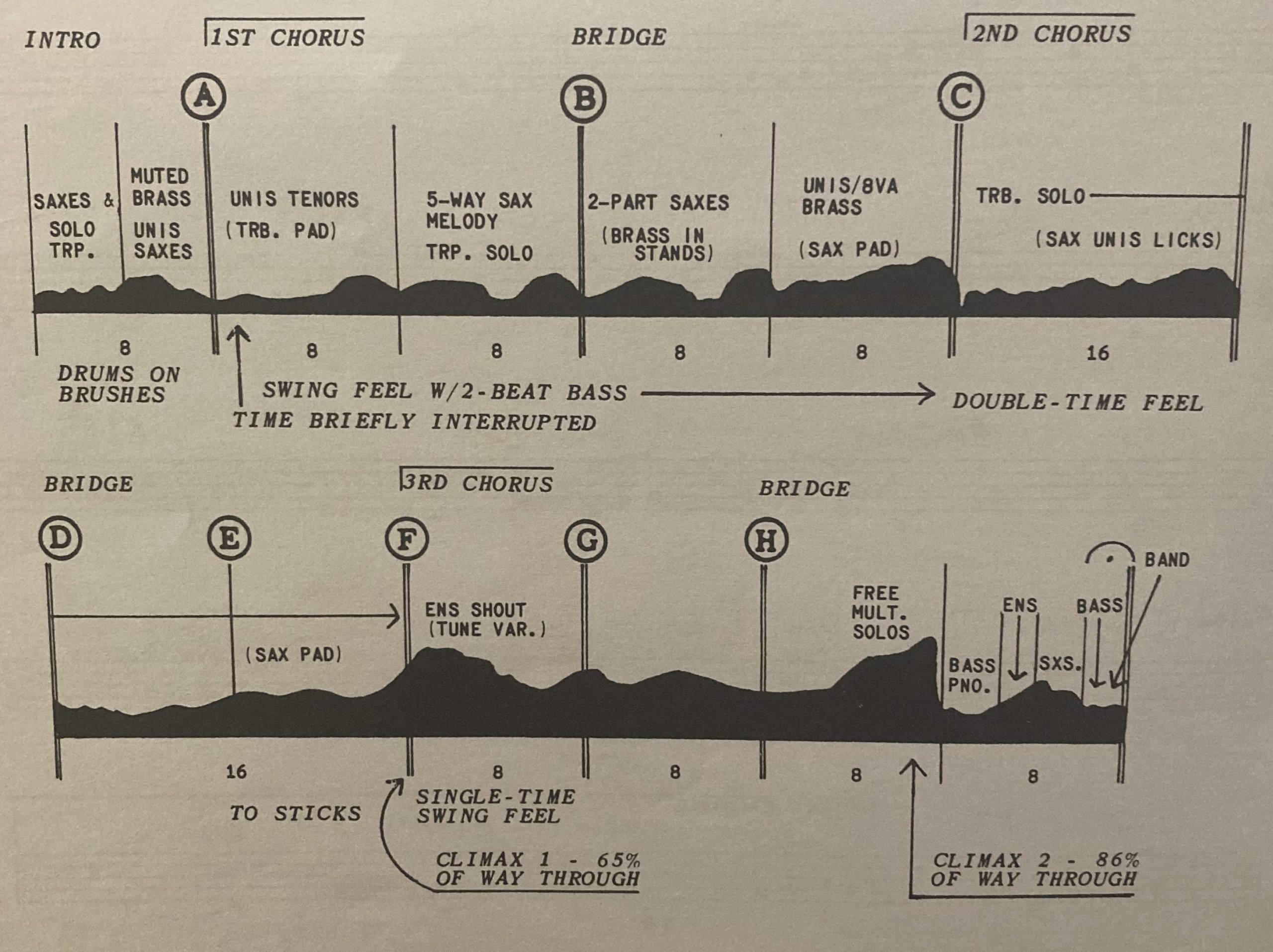
Rayburn Wright in his book, Inside the Score, shows how great pieces of big band music have their peak loudness in the last third of the tune. Moreover, these pieces of music have peaks and valleys throughout, rising and falling at the micro/macro level:

This is Kids Are Pretty People by Thad Jones. Thad Jones has said that his charts have a landing point, and we can see that with climax #1 and #2. Climax #1 is dense and loud, but the stakes are higher in the 2nd where everyone solos in a different key all at once, creating volume, density, chaos, and dissonance. The trombone solo is noteworthy in that it alters our expectations by reducing the ensemble to bass, soloist, and rhythm section after a decent crescendo in the bridge. Music I enjoy, and films, tend to play with expectations in this fashion, and have a clear landing point.
Not only have I used this development curve in arranging and composing, but I see my own music improvisation in this fashion, one idea being developed to its zenith, far away from home, and then returning back again to comfort. The same goes when we zoom in, with each phrase of music having its own curve. For a good example, watch and listen to Jim Hall solo over Autumn Leaves. Try and pick out how he takes an idea and fully maxes out its potential, iterating on it to draw attention and build interest.
I’ll show two more visual examples to really beat this over the head. The hero’s journey, and Rick and Morty :

In the Hero’s Journey, from Joseph Campbell, the message remains the same but the visual changes. Something brings the adventurer away from his comfort zone; he encounters a problem which forces him to cross into the unknown; he faces difficulty and enters an abyss of psychological ordeals; he fails at first, but overcomes his obstacles with new skills, experiencing a metamorphosis; he succeeds and gets his reward, the ultimate boon (maybe tangible, maybe not); and he returns home a changed person.
Rick and Morty is perhaps an easier way to convey the hero’s journey, as it’s explained visually with each moment of an episode:

Music feels similar to me. It’s a moment in time which contains emotional swells of peace and anxiety. Music is unified by chaos, irregularity, disorder, brief comfort, changing dynamics, and walls of sound, but it’s all part of a journey towards resolution. Thad Jones’ Kids are Pretty People plays with dynamics to a point of lunacy at times, guiding the listener to a climax where everyone plays in a different key all at once, but we’ve been guided here, and thus the payoff is sweeter.
Ultimately, using these representations helps bring something down from the abstract/ethereal into the concrete. We bring words off the page and transform them into images, or we structure ideas into a logical order, as with musical form and narrative development. But, for me, this is the foundation which provides logic to an otherwise intangible act of creation. My music does have a structure, and continual themes, and they revolve around the idea of narrative structure. It’s like a collective unconscious for me, something that links art in many forms. Essentially, we’re all working towards a similar goal. It also provides a sense of direction. Creativity is a flow state at best, but I find myself asking the why part of this process. Why do I like the music of Thad Jones? Many would be happy to make art without any regard to how the pieces all fit together, and that’s fine, but I get wrapped up in uncertainty and frustration when I can’t place why my music lacks that Magic—the thing which produces shivers or awe. There’s a thematic focus on something tangible, around which I build a musical identity, essentially giving meaningful qualities to instrumental music.